

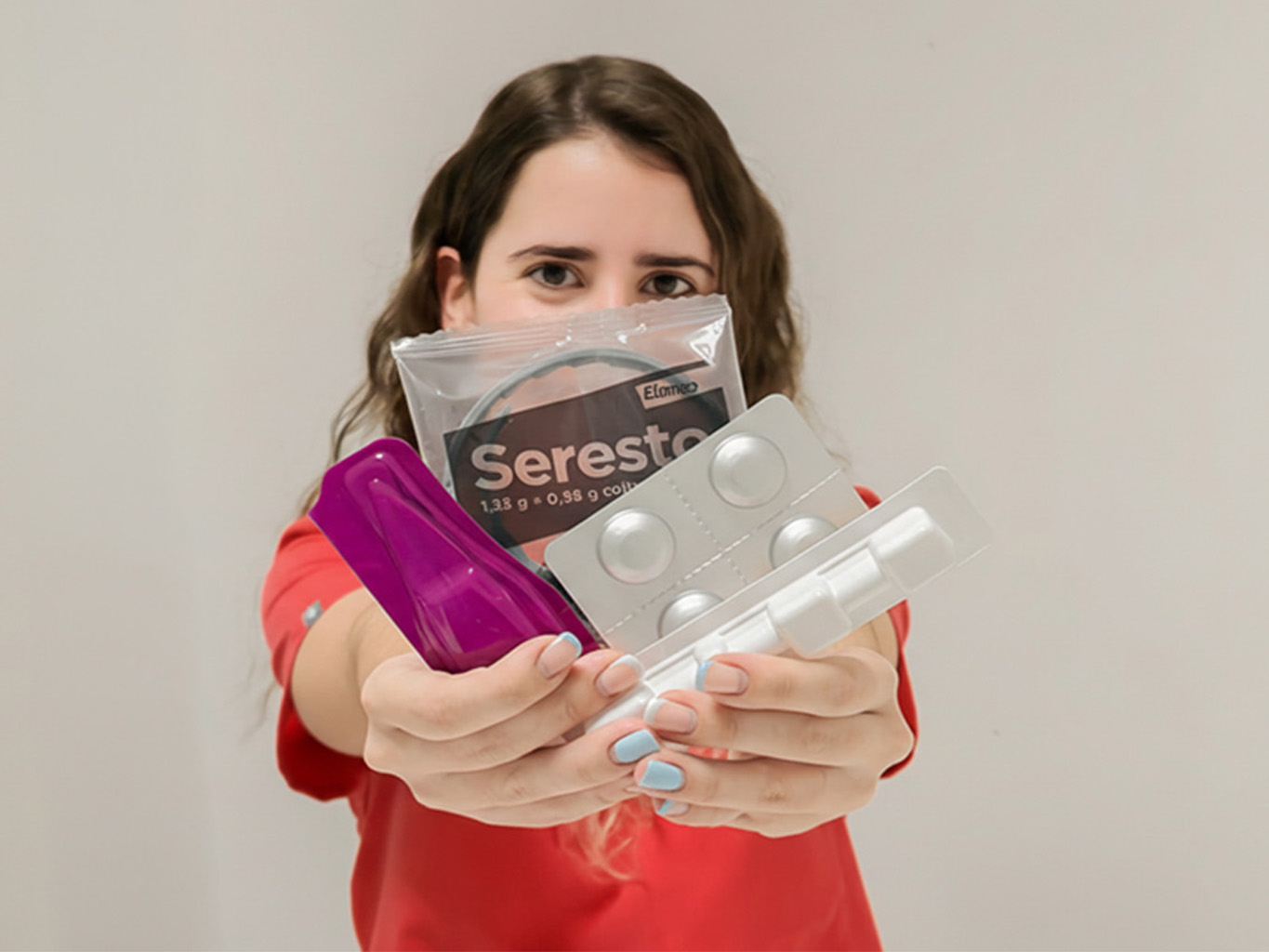
Every day, we often see owners who deworm regularly but still find parasites or signs of discomfort. Most of the time, the problem is not with the product—it’s with how the deworming medication is applied, or that it’s not being done as often as recommended.
A common question during consultations is: “If I don’t see any fleas, is it really necessary?”
The answer is simple: when we see the parasite, the problem is already there.
Deworming acts as a continuous protective barrier and is essential for three reasons:
Protection of the family (zoonoses)
Internal parasites such as roundworms and tapeworms can be transmitted to people, especially children.
Control of environmental infestation
Only about 5% of fleas are on the animal. The remaining 95% are in the environment, in the form of eggs and larvae.
The intervals between deworming treatments are not random. They are defined according to the life cycle of the parasites and the animal’s lifestyle.
A common mistake is to stop protection in winter. However, heating in homes allows fleas to survive all year round, and ticks become active as soon as the temperature rises.
Continuity is the key to effective protection.
If your pet is going to a hotel, traveling, or visiting rural areas, talk to us in advance. It may be necessary to reinforce or adjust the protection.
If there is more than one animal in the same environment, they should be dewormed at the same time.
The frequency depends on the age and condition of each animal.
Puppies and kittens should start deworming between 2 and 3 weeks of age, repeating every 2 weeks until 3 months. After that, protection should be monthly until they are 1 year old.
Adults should, as a general rule, be dewormed internally every 3 months and protected against external parasites monthly (or according to the product).
Seniors maintain the adult plan, with adjustments whenever there are diseases or associated medication.
The plan should always be defined by the veterinarian.
One of the most frequent mistakes is to use a product that is inappropriate for the animal’s current weight. Even small variations are enough to compromise effectiveness.
Golden rule: never administer a dewormer without knowing the exact weight.
We recommend regular weighings, especially for:
Weighing is quick and free at our clinic — and it makes all the difference!
A pesagem é rápida e gratuita na nossa clínica — e faz toda a diferença !
Correct application of the pipette
Administration of the tablet
Use a small amount of wet food
Ask us for a demonstration of the technique if you have difficulty
Home monitoring: warning signs
Even with regular deworming, observe your pet for:
Dragging its tail on the floor
Black spots like “coffee grounds” on the skin
Intense itching at the base of the tail or ears
Do you have a reminder for the next dose?
Did you wash beds and blankets at 60°C after infestation?
Did you deworm all animals in the house on the same day?
Always keep the product box or sticker in the health record. In case of an adverse reaction, it is essential to know the brand and batch number.
If you have difficulty applying the pipette or administering the tablet, bring your pet to CAS- Clínica Animal do Sul. Our nursing team can help you.
Don’t know when the last dose was? Bring the health record and we will help you organize the schedule.
Deworming is a simple gesture—when done thoroughly, it protects your pet, your home, and your entire family.